
Every year the same- The Basis
Winter is slowly coming to an end, the first rays of sunshine are beckoning and right on time, like every year at this time, more and more questions arise that someone wants to start a new hobby and asks for tips, ticks and basics.
This year I would like to summarise the whole thing:
The right Terrarium
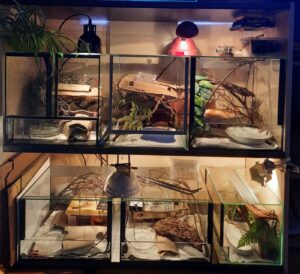
This question cannot be answered in a general way, as it depends on which and how many animals are to be kept in it. Roughly, you can say that for 1-2 males you should not plan below 100x50x50cm. For females not less than 120x60x60cm.
It should be said that Thamnophis can climb, but not very well. All terrariums higher than 60 cm should therefore be designed in such a way that the animals cannot fall and injure themselves.
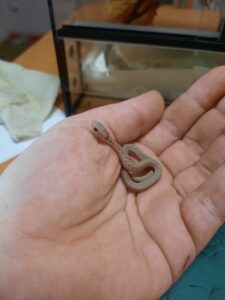
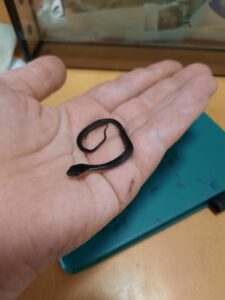
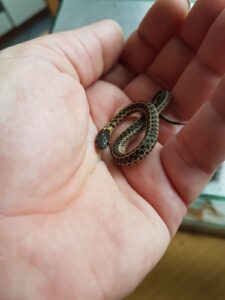
However, this does not apply to young animals. Babies that are ready for release are usually not much bigger than maybe 20 cm. In a terrarium meant for adults, they simply get lost. Finding food is much harder and observing their behaviour is not easier either. I keep young animals in 30 or 40 cm cubes and let them grow first. It is optimal if the terrarium can grow with the animals. Jens Knippel, for example, has a forex terrarium that he can divide in the middle so that he can provide more space as the animals grow.
Currently I have 2,0 one-year-old Thamnophis sirtalis sirtalis growing rather slowly in a terrarium of 40x30x30. But slowly but surely they can move to a bigger terrarium. Another group of 1,2 Thamnophis sirtalis sirtalis Quebec Flame from last year still live in a 80x50x50 terrarium. Also these three have grown better and can soon move into a 100x50x50 terrarium.
So it is not possible to say in general when the animals need which terrarium size, because it depends strongly on the feeding behaviour and the growth of the young animals.
Glass, wood or forex?
That is also a question that cannot be answered in a general way. Wood has the advantage that it retains heat better. Glass is easier to clean, especially if you catch an diseases. I haven’t had any experience with forex so far, so I’ll leave that out for now.
So it is probably a matter of taste and money what you want to have. However, I would always recommend a glass terrarium for quarantine.
It should be said here that no matter which material you choose, you should pay attention to the ventilation. There should be a chimney effect in the terrarium. Especially with the small cubes, you should take a closer look at whether the ventilation is given.
Here’s a tip: Exo Terra terrariums have great ventilation, but the plastic holes at the back need to be reworked. They look very small, but I have already had a one-year-old animal escape through these holes.
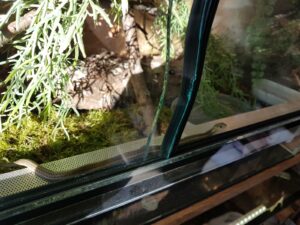
Care should also be taken with terrariums that have sliding windows. Thamnophis are escape artists. If the gap is too wide, they can escape through it.
There are some manufacturers of wooden terrariums whose pane guides are milled into the wood. These are usually too wide for Thamnophis and several people I know have had adults escape through these slits.
A closer look and possible reworking are therefore necessary.
The technical equipment
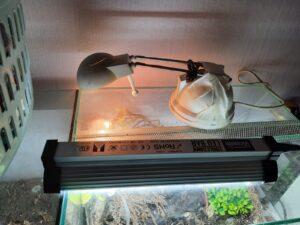
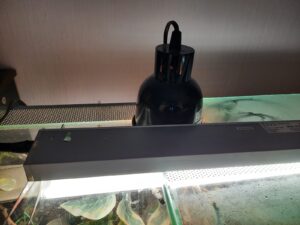
All my terrariums are equipped with a daylight tube and a heat spot. In my wooden terrarium, a 25 W heat spot is enough to maintain the right temperatures.
UVB light can, but does not have to be used. However, the diurnal colubrids are grateful for it. Here too, several long-time keepers have observed that the animals specifically seek out the UVB light, even if it is not placed in the same corner of the terrarium as the heat lamp. It should be noted, however, that the large lamps known from tropical and desert terrariums, which have to be operated with a ballast device, are too strong for our snakes. They also radiate heat and we would simply fry our animals. The neon tubes and the bulbs that are shaped like economy bulbs, however, have a fairly low radiation. So you have to be careful how and where you install UV light so that the animals get something out of it. By the way, UVB radiation does not penetrate the terrarium glass. So there is no point in putting it on top of a terrarium.
It’s a bit more difficult with the juvenile’s terrariums because they are so small that you can hardly install any technology in them. I help myself with halogen desk lamps, which I can then place at the right distance from the terrarium.
I do not use protective baskets for Thamnophis. I have already tried several variants, including self-constructions and conversions, and sooner or later I always had a snake in the basket. The exception here are the adult girls, but they are too big for that. But I had more near-accidents with protective baskets and over the years not a single one without protective baskets with the Thamnophis.
By the way, it was different with my Lampropeltis pyromelana.
The Setup
What should be included in a garter snake terrarium?
A water bowl large enough for the animals to bathe in. Here opinions differ somewhat. There are keepers who have built aquariums into their terrariums and some animals are happy to accept this opportunity to swim. However, the right filter technology must be behind this, as the vipers like to dissolve in the water and so you quickly do not have a beautiful aquarium but a bacteria and germ slingshot in the terrarium. Care should also be taken that the humidity does not rise too high due to the water masses.
Climbing possibilities
As described above, Thamnophis can climb and do so, but they are not very skilled at it. Climbing facilities should therefore be built in such a way that the animals cannot fall too far.
Hiding places
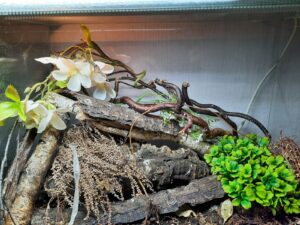
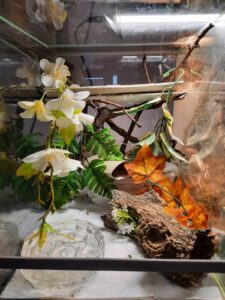
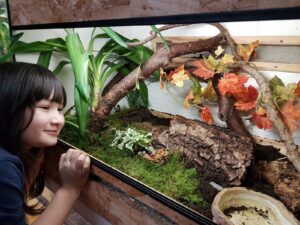
A number of hiding places can be used. The trade also offers some funny and nice possibilities. But for me, pieces of bark that lie relatively flat on the ground and ceramic flower pots have proved to be very useful. Snakes like a certain narrowness in their hiding places, so bark is well suited for this. I break up flower pots with a hammer and file off the edges so that they can’t hurt themselves on them. Especially when these ceramics are lying under the heat lamp, this warm retreat is gladly accepted.
I would like to point out that some flower pots, especially those made of plastic, have holes in the bottom. These should either be made large enough for the animal to fit through, even with a full belly, or removed completely. A few years ago we took over an animal that got caught in such a flower pot and got badly injured. You can still see the scars today.
Plants
Here again there are differences in opinions. Real plants are good for the climate and humidity. But adult females will simply flatten most plants with their mass. Artificial plants are also green and make the terrarium look pretty, and are easier to clean. Since the animals and feeders do not eat the plants, there is no need to pay attention to whether the plants are poisonous. I have found ivy, benjamini, various ground covers and yucca palms to be very effective. These are not necessarily plants from the natural habitat of the animals, but it is the latter that they survive the mass of females on top of them. Sometimes I would put grasses in my terrariums, but they don’t survive the climate very well unless you really water them every day. So basically it’s a question of what you want.
Substrate
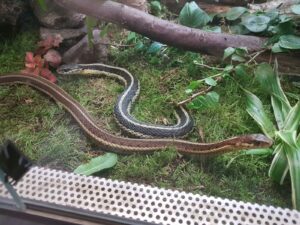
Just as with the planting, the substrate is something where opinions differ. Some swear by litter, others by soil. Since I personally only use soil, I can only report on this. I use peat-free potting soil and prepare it with springtails and white isopods as environmental police. Soil has the disadvantage that you can easily catch fungus gnats. These are not harmful to humans or animals, but they are incredibly annoying.
Temperature and Humidity
There should be a temperature gradient in the terrarium. Under the sunny spot the temperature should be 30-32 degrees and the coolest part of the terrarium may drop to 20 degrees. At night, the temperature may drop to 17-22 degrees.
It should be noted that juvenile animals die of heat stroke or dry out more quickly than they freeze to death. Too warm is just as bad as too cold.
The humidity should be 50-60 %.
Food and Feeding
Thamnophis have quite a wide food spectrum. In the wild they eat worms, leeches, amphibians, fish and rodents. There is still a persistent rumour that Thamnophis can only be fed on fish. However, this is not so easy to realise without the right additives. I recommend a mixture of rodents – preferably fur-free, as fur is not digested – and thiaminase-free freshwater fish. From time to time they also like to eat some chicken heart or an earthworm (earthworm, not red worm, red worms are poisonous).
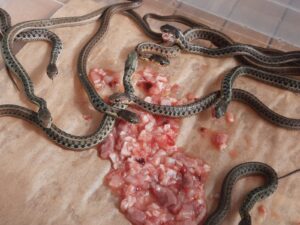
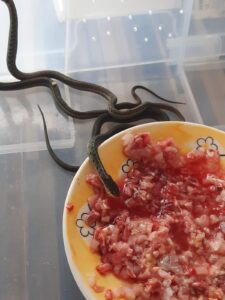
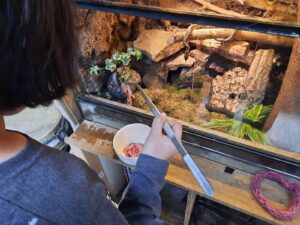
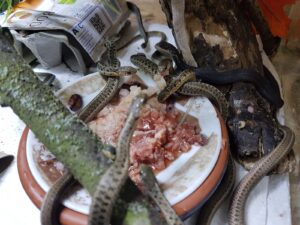
The adults are fed every 7-10 days. Young animals in the first months every 3-5 days, depending on feeding behaviour and quantity. After that every 5-7 days.
A special feature of our colubrids is that the juveniles are still too small to eat whole food animals, with the exception of earthworms. Yes, even a baby mouse is too big and will not fit. This means that, especially in the first year, you should be prepared to cut the juveniles food into small pieces. I have an example of an adult Thamnophis sirtalis sirtalis male, which even now wants to have its mouse cut in half or does not eat it otherwise.
Brumation/Hibernation
Our colubrids need a hibernation period. Martin Hallmen describes this in more detail in this issue of TGS, so I won’t go into it any further detail at this point. There are also several approaches to hibernation. Roughly speaking: approx. 3-4 months at 6-10 degrees in the dark and dry with the possibility of liquid intake.
Which Thamnophis is suitable for me and are there beginner-friendly species?
First of all, no to the second question. You cannot generalise among the species that this or that species is nicer or not. All species are about the same in terms of keeping conditions. Some like it a little more humid and others like their hibernation a little colder or longer. But the basic principle is suitable for every species.
Every keeper will have made his own experiences with his animals, because they are animals of character. I mainly have Thamnophis sirtalis sirtalis and among them I have absolutely curious animals that I can’t reach into the terrarium without them scurrying around between my fingers and also animals that know they have teeth and are not afraid to peck when I get too close to them. My Thamnophis sirtalis tetrataenia, however, are, in my experience, a bit more shy than the T.s.s..
Here, only the exchange with breeders and keepers and the description of the animals helps to get an idea.
Group/communal or individual keeping
This is a question where you will get different answers depending on who you ask. There are keepers who swear by individual husbandry. Others, like me, keep them in groups. I don’t keep any of my animals alone because, in my experience, the animals are less shy and skittish in a group. They are more used to being touched by another living being. Apart from that, there are initial studies that Thamnophis are among the reptiles that make “friends”. This term should not be anthropomorphised. But again, it depends on the individual. There are just as many animals that prefer to be kept alone.
It is possible to keep different species and subspecies together. However, here, as well as in general, care should be taken that the groups are always out of the same sex. In mixed groups even more care should be taken to avoid hybridisation. Thamnophis are viviparous. Once the babies are born, it is too late. This should always be considered.
Quarantine and new additions
The time has come. We have fought our way this far and have decided that, despite the small peculiarities, a Thamnophis should move in. What happens now? First you have to find the breeder of your choice where you can get your animal. As a rule, you will hardly find adult animals for sale, but only juveniles. Once you have found this breeder, prepare the terrarium before the animal moves in. As mentioned above, a 30 or 40 cm cube should be prepared for one or two young animals. The tendency is to set up the small tank nicely straight away. With soil, plants and lots of hiding places. I did the same in my early days, but now I advise against it. Snakes are susceptible to stress and transport is always stressful. Under stress, intestinal parasites can quickly settle in and then you have ruined a nicely furnished terrarium and in the worst case you can throw away all the furnishings.
This means that for the first 4-6 weeks you should do yourself and the animal a favour and line the terrarium with paper towel or newspaper and choose hiding places and climbing possibilities that you can simply throw away if in doubt. Empty plastic tins, egg cartons and toilet paper rolls have proven to be useful. Before the addition is put into a properly furnished terrarium, a faecal sample should be submitted and examined. No matter how good the breeder is, no matter how conscientious and how much you trust them. It can ALWAYS be something and it doesn’t even have to be the breeder’s fault. As mentioned above, even transport can be a trigger.
Quarantine also has the advantage that you can observe the animal better. Does it eat properly, does it shed its skin properly? Are the movements OK?
Quarantine is best done in a different room, especially if you have more animals than just the new additions.
Care
Snakes are not cuddly animals. There may be individuals that come to be touched on their own, but this should not be a prerequisite. Keeping a Thamnophis consists mainly of watching and being watched. This should be clear to everyone. The terrarium is the habitat of the animal, just like the aquarium is for fish. Nobody has the idea of taking the fish out to cuddle. Feeding should be done about every week, as described above. The water should be changed daily and if you don’t have a bioactive system with environmental police, the excrements are collected as soon as they are seen.
That’s how tiny Thamnophis are after birth:
Text and Photos: Jennifer Rejchel